Thursday, April 28, 2011

Sri Mahipati Rayaru


( 1611- 1681)
Aradhanaa:    Margasira Amavasya

Sri Mahipathi Dasa was the son of Sri Koneri Rao, an orthodox and ardent devotee of Sri Hari. When Koneri Rao wanted to perform the Upanayana of his son, the astrologer who saw his horoscope predicted that Mahipathi would lead a royal life and become a sacred yogi.Mahipathi continued his early education with his father and became a popular scholar like him. He became very fluent in Sanskrit, Marathi, Hindi, Kannada, Urdu and Persian. His philosophical discourses were very popular and attended by thousands.
One day, Khawas Khan,  a minister in Adil Shah's court was passing by the Narasimha Temple in the town,  where Mahipathi Rao was conducting a discourse on Purana, and saw thousands of people listening to his  discourse. Khan listened  to his talk for some time and liked what he heard. He wanted a discourse to be conducted in his house too. Mahipathi immediately agreed to do so, as the Sultans were known for their brutality & also generosity, if they are happy. 
The next day, Mahipathi conducted a discourse in Khan's house. He explained incidents from Bhagawatha, Ramayana etc in urdu and parsi, languages which the people in the ministe's house  understood. His discourse was so well liked that it became a practice and later on,  discourses were conducted both in Khan's house and the temple. Many muslims, including mullas, attended his discourse and appreciated his knowledge and scholarship in Puranas & Scripture.
Once, the Nawab's Lekhadars, Accountants  were in trouble,  as they could not rectify a mistake in their accounts. Some one in the Palace  suggested that Mahipathi Rao,  should be consulted as he was good at accounts. When Mahipathi verified the accounts , he immediately identified the error. 
The Nawab was very happy and appointed Mahipathi as his courtier, as also a Manager of Accounts. Eventually, Mahipathi's sincerity and hard-work made him the Diwan of the Province.
Mahipathi married a girl called Tirumala, and led a very simple and austere life, even though he could afford luxuries and comforts. Still he continued eating Jola Bhakri & Akki Nucchu as earlier. He was not elated by the new post or power. 

Turning towards the inner Self

In Bijapur, there lived a brother and sister called Shahanunga and Shahanungi. They belonged to the Soophi sect and were very popular as they could predict the future,  show their Mystic Powers. However, their existence and character seemed  a mystery. No one in Bijapur, knew where they lived, what they ate, or wore.  Most of the time they appeared nude & wore rags. They were very pious and respected by both Hindus and Muslims.
One day, Mahipathi was inspecting some construction work on the banks of  Begum Talab, a water tank. Shahanunga appeared from some where,   and was curious to know what Mahipathi had in his hand. Mahipathi  Raya told him that it was the Nawab' s Signatory Ringring (raja mudra) given to him as he was Diwan of the Province
Shahanunga  stretched his hand asking Mahipathi to give  him the ring and upon receiving it, threw it into the the tank. Mahipathi was scared as the ring was a symbol of the Nawab's position and power, and could not be trifled with.  
He pleaded with Shahanunga to retrieve the ring. Shahnunga asked his sister to get the ring. She immediately  plunged into the tank and retrieved hundreds of identical rings from the water.
The baffled Mahipathi could not identify the Nawab's ring and requested Shahanunga to help him, whereupon Shahanunga retrieved his  original ring and uttering the words 'mouth kaa ghan, (smell of stinking dead body)   with this' and  he disappeared.
Mahipathi could not understand Shahnunga's utterance [mouth ka ghan  means smell of dead body] or its significance. After pondering about this for a while,  he gave up and decided to approach Shahnunga himself for an explanation. This was not easy as Shahnunga's whereabouts were difficult to predict. Finally, after great effort, Mahipathi finally met Shahnunga and prostrated before him, asking him to explain the significance  of his words and accept him (Mahipathi) as a disciple.
Shahnunga told him, I am not a Brahmana, like you,  to go to Bhaskar Swamy who was in Saravada and accept  him as your Guru. 
Renouncing Diwangiri 
After this Mahipathi Rao  decided  to give up his position and go to Bhaskar Swamy.The  Nawab was initially reluctant to let him go,  but as his Junior wife wanted her brother to have a seat of Power in Palace, agrred to relieve him after gifting wth Gold & wealth to Mahipati Rao. Even Tirumala was happy with Mahipathi's decision and decided to accompany him to Sarawada.
Bhaskar Swamy was very famous in Karanataka and Maharashtra. Even though Sarawada was a small village, his presence attracted a number of devotees, turning Sarawada into a piligrimage centre.Mahipathi and his wife went to Bhaskar Swamy for obtaining sacred and philosophical knowledge. Bhaskar Swamy accepted Mahipathi as his disciple and gave him Upadesha. He also blessed the couple to have illustrious children. Mahipathi and his wife stayed with Bhaskar Swamy for some time before going to their native place in Bijapur.
Later, Mahipathi went to Shapura village in Gulbarga district, where he selected the Sri Hanuman Temple on the banks of the Mandakini river for his Spiritual  activites. From then on, he became known as Mahipathi Dasa and composed many songs with the ankitha 'Mahipathi'. He spent the rest of his life conducting philosophical discourses, bhajans and other devotional activites.


kOlu kOlennakOle kOlu kOlennakOle
sadvastuvina balagoMbekOle


kOlunikkuta banni bAlErellaru kUDi
myAlye maMdirada hAdEli kOle
myAlye maMdiradoLu bAlamukuMdatAnu
lOlyADuta oLagiddAne kOle


AdigiMtalyade hAdi anAdiyu
sAdhisa banni odaginnu kOle
sAdhisi baralikke sAdhyavAgutalyAde
bhEdisi nODi manadali kOle


kaNNinoLihya bOMbekANabaruttade
jANyEru nIvu tiLakoLLikOle
jANyEru nIvu kANade hOgabyADi
jANrisuthAne sadguru kOle


sadgurupAdake sadbhAvaviTTu nEvu
sadbhOdha kEli sAdhisi kOle
sAdhisi kELi nIvu budhajanaroDagUDi
caduratanadali ati byAge kOle


arahuveMda sIreyanuTTU kuravheMba kuppasali
iruvaMti puShTali muDidinnu kOle
muDidu baralu pUrNa oDigUDi barutAne
baDAvanA dAri balagoMbe kOle


balagoMbe sAdhanavu nelegODu mADabEku
valavhAMga tAne SrIhari kOle
SrIhari muMde nIvu sOhya tiLidubanni
sAhyamADuva ihaparake kOle


ihaparake dAta mahipatiswAmi
sahakAranobba SrIpatikOle
SrIpatistuti kODaDalikke pUrNa
bhukti muktiya nEDu tAne kOle|| 


Sri Mahipathi Dasa had two sons - Devaraya and Krishnaraya. Devaraya chose the career of a warrior and became the leader of some small army. Krishnaraya followed in his father's footsteps and became a haridasa,  Guru Mahipati Dasa and composed many songs. 

हिन्दी भाषांतर:
श्री महीपति दास  कर्नाटक की हरिदास परंपरा  मे एक अनोखा संत दार्शनिका और योगी थे| उन्होने अपनी कृतितों मे विष्णुभक्ति की प्रचार कराते हुए योगा साधना और प्राचीन योग रीति से बहुत परचित थे| वह दूसरे हरिदास जैसा सिर्फ ज्नान, भक्ति और वैराग्य की अनुभवी थे| वे  अपनी कृतियों मे उर्दू,  फारसी और संस्कृत भाषा की प्रयोगा भी की थी| 
श्री महीपति राया एक सुल्तान के सचिव होते हुये भी अपनी कृतियों मे लौकिक जीवन की अशाश्वत स्व्स्भाव, अनिश्चितता और मोह मे कभी नही पड़े| 
उनकी योगा गुरु एक महान वैराग्यशील साधु थे| उसकी नामा भास्कर योगी था| यद्यपि वैष्णव संप्रदाय की अनुवर्ती थे, परंतु योगमार्ग के द्वारा भागवत साक्षात्कारा की प्रवृत्ति इसकी क्रियों मे हम देखते हैं| कर्नाटक राज्य का अनुशाना जब आदिलशाह करता था, ताबा श्री महीपति जी उसकी अमात्य और मार्गदर्शका थे| एका दीना इस अधिकारा की लालच छोड़ कर हरिदास बन गए| उन्के पुत्र कृष्णराय भी एका महान साधका बन कर हरिदास बन गए| ऐसे पिता-पुत्र की हरिदास बनाने की उदाहरण श्री पुरंदर दासजी की जीवन मे भी हमे दिखाता है| महीपति दासजी की दोनों पुत्र-  देवराया और कृष्णराय भी  कर्नाटक हरिदासा परंपरा को अपनी योगदान दिये है| अभी श्री दासजी जी आराधना उनकी समाधिस्थाना काखण्डकी मे मनाए जाएगी| 

Wednesday, March 23, 2011

Sri Vyasarajaru

Sri Vyasaraja Swamy  has a distinct  place amongst Madhwa saints. He was a child prodigy who learnt under great Guru Sri Sripadarajaru at Mulbagal, and  for some time at Kaanchipuram.He was adopted by Sri Brahmanya Tirtha as a child. Born as Yatiraja to Ramacharya couple at Bannur, Sosale,  in April 1447 near Mysore, he  widely travelled across nook and corner of India.
The task before Vyas raja was extremely challenging. More scholarly Advaitins were taking cudgels on him. Each one of them was a stalwart. On the other hand,  he had Logicians from Bengal like Pakshadhara Mishra, widely known in scholarly circle of those days. They had shut the mouth of Advaitins and  Visisht advaitins in their strong,  subtle fallacious arguments. Some strong scholar like Vyasa Tirtha was needed for those days to silence them ! it was not an easy task ahead ! They had all studied Nyaya Shastra & had already discovered a new style of argument called Navya nyaya from Navadweep. None in India dared to tackle them.


Sri Vyasarjara Guhe- a place where he used to revise  what his guru, Sriapdarajaru taught him.


They landed in Mulbagal to argue with Sripadarajauthe great Guru wanted to show how his young Shishya could easily do this task. He commended Sri Vyasa muni to do this job, which he did it gracefully. Pakshadhara's wings  were cut by him effectively. He surrendered his Jayapatram & returned home.
Social services rendered by him were not less, any way. He constructed (Bettakere)  Vyasa samudram lake, which helped many farmers. He built many Agraharams for the needy scholars. He honoured Kanaka Dasaru and took him to Haridasa  fold.
He  was the Raja Guru of  Krishnadevaraya, from whom he was honored profusely. When Salva Narasimha II had massacred the erring Archaks of Tirumala, he worshipped  Srinivasa there for 12 years and returned the Pooja authority to the members of the family of Priests, who had survived the King's rage. If he had continued Pooja,no one could have objected to him. But as Yati would behave, he handed over the Temple to a surviving Brahmachari, returned back to Karnataka. His Mutt is called Vidya Simhasana as many scholars like Jagannatha Tirtharu of Bhashya Deepika fame, Seshachandrikacharya ( Raghunatha Tirtha)  & Kambaloo  Ramachandra tirtharu succeeded him.
He is a noted Haridasa of pen name Sri Krishna, bestowed on him by his Guru Sri Sripadarajaru.In fact, he was praised by his own Guru in one of his kritis.  
ಏಸು ಮುನಿಗಳಿದ್ದರೇನು? ವ್ಯಾಸಮುನಿ ಇರಲಾಗಿ- Esu munigaliddodenu, Vysa muni iralaagi. A Certificate from a great Guru to a great Shishya. 
Sri Vyasa Tirtha sings in praise of his Vidyaguru Sripadarajaru- " Vaadigajamastakaankusha Vibudhajanageya Medineesuravandya Sripadaraya". His Suladis and Ugabhogas are deep in philosophy of Madhva thought. He composed Songs in praise of Acharya Madhva, Jayatirtha and Sripadaraya ( Lakshminarayana Yogi) 

One of the most popular  Devaranama in Yaman Kalyani, ಕೃಷ್ಣಾ ನೀ ಬೇಗನೆ ಬಾರೋ . is confused to be written by him.. Researchers say that it was written neither by him or his dear disciple Purandara Dasaru! with that of Purandara Dasaru. He installed as many as 700 Hanuman statues from Hampi to Tirumala. THe first was at Chakra Tirtha on the banks of Tungabhadra, second at Mulabagilu near Sri NarasimhaSwamy. All the statues have a Bell tagged to Hanuman's tail. That is the style  of Sri Vyasarajaru. 
We can see a small cave where he did his svadhyaya, revision of what Sripadarajaru  taught him daily, in Narasimha Tirtha. (Once I tried to sit for meditation & got fever for 2 days, without my father's permission, as we were daily visitors there before Archaks arrived!!My father had done Nirmalya seva many times, whatever Dakshina he got from devotees for Arati, he promptly gave it to Archakas as he did not need money!)
I can write more about Vyasarajaru. But I am afraid of his radiance still existing in Mulbagal. Well, I should  mention his Vyasatraya, Tarka Tandava, Nyayamritam & Tatparya Chandrika, ( Incomplete, later completed by Sri Raghunatha  Tirtha of his lineage), and Bhedojeevanam is another work on Madhva thought
Sri Sri Vyasatirtharu  entered Brindavanam in March 1539. Purandara Dasaru described his last moments in a Kriti. His Brindavanam lies in Navabrindavanam, with Sri Padmanabha Tirtharu, Srinivasa Tirtha, Rama Tirtha  and  others. It  is one of the most well carved structure among 9 Brindavans there, unfortunately vandalized by antisocial elements, later restructured as earlier. 


Thursday, March 3, 2011

Srimad Bhagavatam - I


Earlier we had discussed on the importance of Bhagavatam. Pareekshit was the grand son of Panadavas. He was born to Uttara, wife of Abhimanyu. When AShvathama decided to kill the entire Pandava Clan, Bhagavan Krishna comes to save the unborn child in Uttara's womb from his Brahmaastram. Hence his another name, Devaraata, God saved Kid. We also know by now that he was cursed by Shrungi, son of Shameeka. His death is known to him. He wanted to go on fast till death ( Prayopavesha). The Rishis & people of his kingdom were worried as he ruled as a benevolent king for 36years, avoiding the Evil, Kali to enter his Province. 


Pareekshit was waiting on the banks of Ganga, when Shukacharya, son of Bhagavan Vedavyasa arrived unexpected, to bless him. God sends saints to help his devotees when they need Support & enlightenment. Shukamini was blessed by his father. He had learnt Bhagavatam from its Composer himself.
When all the Puranas 17 in number & Mahabharatam seem to lack some thing very useful for seekers in Spiritual path,  in Kaliyuga, Vyasadeva on the behest of Rishis, taught Bhagavata to his son Shuka, an avatarof Bhagavan Shiva,  a Parama Vaishnava, an ardent devotee of Sri Hari, who preached the greatness of Ramanama. 
Srimad Bhagavatam in its present form has 12 Books called Skandhas, 18,000 Shlokas & about 343 Chapters. 
It has been widely interpreted by scholars of all the three faiths. Chitsukhaacharyaa of Shankara tradition, Veera Raghavacharya from Vishistadvaita, & several from Dvaita School of Madhvacharya. Among them Vijayadhwajweeya or Padaratnaavalee is very ancient & popular. THe Author Shri Vijayadhwaja Tirtha was from Pejawar Mutt, Udupi, whose Brindavan is near the Arabian sea at Kanva Tirtha. 
Pareekshit welcomed Shuka Muni, who came there as God sent, greeted him and asked him some very pertinent questions of a seeker. He asked him, ' What should   a person do at the time of Death? What are the most important things to be heard and followed? 
A very simple looking, yet meaningful Question indeed. The answer to this Query is Bhagavatam ...... 
निगमकल्पतरो: गलितं फलं 
शुकमुखादमृतद्रव संयुतम्।  
पिबत भागवतं रसमालयं  
मुहुरहो रसिका भुवि भावुका: ॥ 
 ·  · Share · Delete

Skandha II Bhagavatam


Shuka Muni has arrived there. They say a Guru comes in search of a disciple. Pareekshit prostrates before him, offeres all the welcome rituals to a Rishi  and asks him What shall I do? My death is destined to happen in a week. Tell me  a way out, not to escape from Death, to have a better & peaceful end. 
Shukacharya is pleased to tell him. Of course he has come to help him. He knows Kali has entered.  
God  has given him a golden opportunity to play his foul game on humans ... ! Dharma has been sidelined, men & woman  are careless on integrity, character, Faith ... But more  interested towards merry making, falsehood, disrespecting elders & the learned more than ever before.... 

There are 33 Chapters in this Skandha. 
The First 3 Chapters are  Shuka's advise to Pareekshit  to Meditate on Shri Hari. How? by listening to his greatness, singing in his praise as he is the Creator,Protector & Dissolver of the Universe created by Him at His Will. No  one should have any hesitation in this.
Ask him nothing about your wordly needs... He knows & provides you on time.
Have Bhakti, Sincerity in what you do, listen to anecdotes related to Him & his Devotees. Ch 4 deals with a Question by Pareekshit about the secret behind this Creation of Universe fantastic ! How systematic, disciplined, well sculpted yet... different... 
Shukamuni is now happy that the King is on the path of Realization.. Narayana does it depending onKala, the right timing, Karma, the Rightful deed... He is Virat, one with all pervasive nature. By this Virat Svaroopa, He does the entire job in the name of Brahma, and finally swallows in his womb as Rudra.. in its Atomic form.... This has been testified clearly by Purusha Sookta in Yajurveda.. 
Even then knowingly we do all unnecessary things as sheer, criminal waste of our precious time talking about  others, most of the time, without bothering the moments last... Sun sets, our life shortens by a day... we are nearer to Death, yet we feel like Immortals... thats Maya , which binds us all...
Bhraanti Jnana Sukhaakshanaam Dukhameva Sukhaayate - For us in Illusion, miseries seem to be happiness... Our Vision is blurred... 
Apashyatyaatma tattvam Griheshu Griha medhinaam ...  We never introspect amidst our daily chores... never think about God or Dharma... deeply involved in other activities. We spend almost half our life in Darkness. ... Laziness... 
We should know the clear cut division in us - Aham it is me Jeeva, Sa: it is Him, the God. notSoham... I am Him...  We should know if not realise the Parallel existence of God & Jiva. 
Both Him & Me are eternal Truth. ... but they  are distinct & never Identical ... We exist because of Him & His Grace. 
Shuka Muni says: Mahat Gataanam Viramaaya Tubhyam PravatayeBhagavatam Puraanam || 
I shall narrate Shreemad Bhagavatam  to help you to have the Real Happiness, not the apparent, seemingly good Happiness... 

Wednesday, February 16, 2011

Pibata Bhagavatam Rasamalayam.


From my childhood,  Srimad Bhagavatam  has created lot of curiosity in me. It has come as handy during my extremely  bad days as an Elixir or  Tonic Consolation. It has made me to understand that acquiring Panditya never leads  anyone to happiness, peace or consolation if not Moksha. Many a time people argue that a Madhwa's life has no meaning without  a Study or Patha of Srimannyayasudha.  I pity them ! I agree to disagree with them ! They are puffed up, biased & short sighted. Very rarely they open their eyes toTruth. Shankaracharya knew Bhagavatam, but never quoted this great Puraana Raaja. Probably he had his own fears. 


I have great respect to Nyayasudha or any polemic text.
Let me tell you, what the Acharya has for us an a Dictum. 

Alodya Sarva Shaastraani Vichaarya cha puna: puna: |
Idamekam Sunishpannam Dhyeyo Naraayaana: Sadaa || 
- After a thorough search of all Shastraic LIterature, contemplating in eternal Truth repeatedly, I would say this is the extract of such a stupendous Research. Meditate on Narayana.  always... 


Monday, January 24, 2011

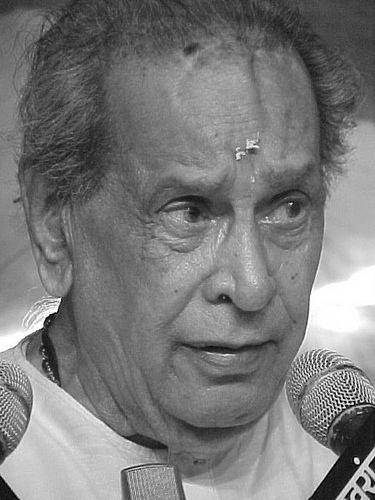
Bharat Ratna Pundit Bhimsen Joshi


Well known Hindustani  vocalist Pandit Bhimsen Joshi, who enthralled generations of connoisseurs with his  marvelous renditions of  classical music, passed away Sahyadri hospital, Mumbai  on Monday, 24 January   after a prolonged illness. He was 88.
Born to Pundit Guracharya Joshi, a noted Sanskrit scholar on Feb 4, 1922, at Gadag, Bhimsen was a child prodigy.  He fell in love with Music at a tender age of 9. He ran away from Dharwad to join Kirana Gharana at Gwalior, under the maestro of those times,  Ustad Abdul Karim Khan.Mr. Joshi got a boost to his career during a concert in Pune in January 1946, at the age of 24,  on the occasion of the 60th birthday of his guru Sawai Gandharva. 
Pandit Bhimsen never compromised with his quality of singing. He had renderd a song in Kannada movie Sandhyaraga, of Anakru, a celebrated Kannada novelist. Nambide ninna...  which was a hit song of 1970s. His association with another Music maestro Dr. M. Balamuralikrishna, some times ended up in a quarrel, GV Iyer, the Director pacified the two elephants !!  
What distinguished him from the ordinary Vocalists  was his powerful voice, amazing breath control, fine musical sensibility and unwavering grasp of the fundamentals that made him the Maestro of  Hindustani Music, representing a subtle fusion of intelligence and passion that imparted life and excitement to his music.
 Apart from his classical singing he lent his voice to Hindi movie Baant Bahar, and Bhairavi.  Mr. Joshi sang  as a dhrupad singer for a Bengali film based on the life of Tansen and later sang as a playback singer for Marathi film Gulacha Ganapati, produced and directed by celebrated Marathi humorist Pu La Deshpande.  
But it was his Sant Vani recitals, which bore the flair of Marathi Bhakti Sangeet   and compositions of Haridasasof Karnataka that added immensely to his popularity in both Maharashtra and Karnataka which have had a long succession of saint-poets.
He was honoured with the Padma Shri (1972), Sangeet Natak Akademi award for Hindustani vocal music (1975), Padma Bhushan (1985) and Madhya Pradesh government’s “Tansen Samman” in 1992.  The nation’s highest Civilian Award Bharat Ratna was bestowed on him in 2008.
Mr. Joshi had undergone a surgery for removal of a brain tumor in 1999 followed by a cervical spine operation in 2005.
The maestro’s last surprise public performance that enthralled the audience was during 2007  Sawai Gandharva annual music festival which he himself had started to commemorate the memory of his guru.
People of Karnataka remember him always for his rendition of  Dasavani. His Kangalidyaatako kaveri Ragana nodadaa.. of  Sri Sripadarajaru,  ‘Kailasavasa Gureesha Eeshaa… of Vijaya Dasaru, Bhagyada Lakshmi Baramma… of Purandara Dasaru, several compositions on Sri Raghavendra Swamiji of Mantralyam,composed by Abhinava Janardana dasaru  are very popular in Kannada. 
 The Government of Karnataka honoured him. 
Courtesy  Minister Mr Suresh Kumar's collection) 
He was a great devotee of Sri Raghavendra Swamiji of Mantralayam. In fact he ran away from home at 11 years of age to Mantralayam. After receiving Sri Raghavendra’s blessings, he travelled to distant  Gwalior with the unsurpassed urge for Music.
Let his Soul rest in Peace. Karnataka missed him. Maharashtra gained him.

Wednesday, January 5, 2011

Scholarship VS Humility

   It was way back in 1990. I wanted to take an Interview with a renowned Jnanapeeth Award winner. He bluntly said: I have nothing to speak to you personally. Whatever you have heard of me & known from my Books, you can write, sans controversial statements et al., He was a celebrity who has reached certain heights. I can understand Egotism, he might have, but should not be. I have spoken to many Scholars in the West. They are down to earth people with no airs over them. No auras attached to them. But when I speak to some scholars here, they either say, Sorry I dont have time.. or move away from there. That is what Bhavabhuti says: Jeernamange Subhashitam - Whatever  he wanted to convey got  aborted when he spoke to scholars, common people didn't understand him. What else he could do? Many of our Questions sincere or otherwise remained unanswered by this Attitude of Scholars. 
Today I had a similar experience again. .I was chatting with a Student, (not of mine) on my Face Book. He is a student  of  a Vidyapeetha, a place where scholars are made. He asked me: Do you know me? When I said i am his FB friend, he again asked me who I am after much info given by me. I was perplexed. I said, you are still a student, dont be so rude. He said sorry and so on... It is humility or normal behaviour  which is needed for all at all ages. It fetches people to you. That is what I believe. But why only Language Scholars or some one  in the offing should be so rude I hardly understand. Most of Sanskrit Scholars are very rude & puffed up. Some are very humble, yet they are uncared for. That's the irony of the scholarly circle. 
When you ask them a genuine Question, they say: Do you know Panini's Asthadhyayee or Tarkasamgraha or Siddhanta Koumudee? Then I can speak to you, else no way.

I remember my father's words. All Scholars are not enlightened. They are masters of letters. They cannot deliver anything good to the Society. 
When Saibaba of Shirdi  was asked by a devotee to explain the meaning of Ishavasya Upanishad, he told him, go and watch what  the servant maid of Kaka Deekshit was doing. He was annoyed as Scholar as he had nothing to learn from  a Servant. However, he went there. She was washing clothes. She was offered a new Saree by Deekshit's wife.  She expressed her happiness. Next day, she was happily singing a song with same old clothes and was as happy as she was the previous day !! Tena tyaktena bhunjeethaa: maa krudha: kasyachiddhanam  -  Be happy with whatever God has given you. Do not covet what others have. An illiterate person was practicing the message of a great Upanishad, without her knowledge.
 Literacy, Scholarship & Life are all unconnected things. Only Humility can connect them better. 

Intellectual debates between rival schools

There are few instances in the history of Indian schools of thought, particularly Vedanta where there were debates and dialectical argumen...